


28 Oct What Happens Between Play and Learning? Understanding What Your Child Is Really Developing at Preschool
A child builds a tower with blocks. It falls. They move a block to the base, try again and watch what happens. The activity looks simple, but the child is testing an idea, noticing a result and deciding what to try next.
Preschoolers do not develop only when an adult explains something or a worksheet is completed. Meaningful experiences invite them to explore, communicate, make choices and experiment. Understanding this process helps parents recognise the learning taking place during everyday preschool activities.
Play Is Where Children Make Connections
Young children learn about the world by interacting with it. Imagine a child pouring water between containers. They may notice that one holds more, adjust how they pour or investigate what happens when water spills. The experience offers opportunities to compare quantities, explore cause and effect and solve small problems.
This is one-way preschool learning develops through experience. Children test ideas and connect new experiences with what they already know. They may not immediately have the words to explain what they have discovered, but their actions can offer clues about their developing understanding.
What Can Children Develop Through Play?
Thinking and problem-solving
Puzzles, sorting games and building activities invite children to notice patterns and try solutions. When a tower falls, rebuilding it offers a chance to change the design and test another idea.
Language and communication
Stories, songs and pretend play give children reasons to listen, ask questions and express ideas. When they pretend to run a shop, they might name objects, negotiate roles and speak with playmates. Language becomes useful because it helps them communicate for a purpose.
Social, emotional and physical development
Playing with others can involve taking turns, sharing materials and handling different opinions. With appropriate adult support, children can practise expressing feelings and navigating disagreements. Drawing, threading, dancing and outdoor movement also offer opportunities to practise coordination, from handling small objects to running, jumping and balancing.
Why play based learning Needs Thoughtful Guidance?
Enjoyment alone does not make every activity a meaningful learning experience. Effective play-based learning combines room to explore with thoughtful planning and appropriate teacher involvement.
If a child keeps building short towers, a teacher might offer blocks of different shapes or ask, “What could help it stay up?” The child remains the problem-solver, while the question or new material opens another avenue to investigate. The teacher observes, offers a manageable challenge and allows time to test an idea rather than immediately providing the answer.
The National Association for the Education of Young Children explains that playful learning can combine a rich curriculum with a playful approach. Free play, guided play and direct instruction can all have a place when used thoughtfully for children’s needs and learning goals.
What This Looks Like at MBIP?
At Mainadevi Bajaj International Playschool, the documented pedagogy includes music and song, stories and poetry, hands-on experiences, observation and meaningful interactions.
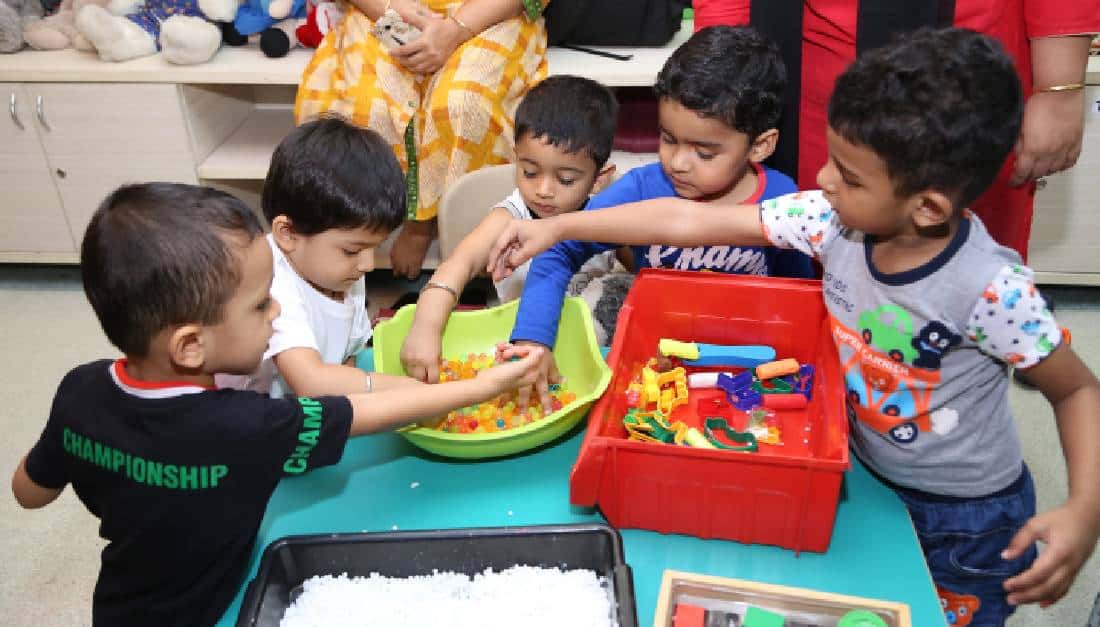
These experiences create different opportunities for participation. During storytelling, children can respond to events and discuss characters. Music and movement invite them to notice rhythm and coordinate actions. Art and hands-on exploration let them investigate materials, make choices and observe results. Teachers can notice children’s responses and use questions or new materials to extend their exploration.
This is learning through play in practice: children explore while adults provide suitable materials, guidance and support. It does not mean leaving children without structure or expecting every activity to produce the same result for everyone.
What Should Parents Look for at Preschool?
When considering preschool education, parents may look for visible progress, such as artwork, new vocabulary or counting skills. Those observations can be useful, but they are only part of the picture.
Look at what happens during an activity. Are children encouraged to ask questions and try different possibilities? Do teachers give them time to attempt a task before stepping in? Are they invited to explain ideas, work with others or return to a problem? Can the teacher describe what children are exploring, beyond simply naming the activity?
These questions help parents understand whether play is being used thoughtfully rather than simply filling time.
Why the Process Matters?
A finished drawing or completed puzzle shows the result, but not every decision or discovery along the way. Children need opportunities to experiment, make mistakes and try another approach without every attempt being judged by its outcome.
Early childhood development involves interconnected areas of growth, including thinking, communication, movement and social-emotional skills. Children may demonstrate these abilities differently across activities and over time. A single worksheet or milestone cannot tell the whole story. This reflects the National Association for the Education of Young Children’s principles of child development and learning.
The goal is not to turn every moment into a lesson. It is to provide meaningful experiences in which curiosity has room to grow and children can participate actively.
FAQs
How is guided play different from free play?
Free play is largely directed by children, while guided play involves an educator providing materials, questions or prompts to extend exploration. Both can have a place in a thoughtfully planned preschool environment.
How can teachers extend a child’s learning without taking over?
Teachers can observe, introduce suitable materials, ask open-ended questions and offer help when needed. This gives children room to test their own ideas while receiving support.
Can one preschool activity support several areas of development?
Yes. Building with blocks, for example, may involve coordination, problem-solving, communication and collaboration. The opportunities depend on the activity and how the child engages with it.
How can parents recognise learning that is not visible on a worksheet?
Notice whether a child tries different approaches, asks questions, explains an idea, uses a familiar skill in a new situation or becomes more involved in an activity.
Does play replace direct teaching in preschool?
No. Play, guided exploration and direct teaching can complement one another. Educators can choose an approach according to the learning goal and children’s developmental needs.
Sorry, the comment form is closed at this time.