


18 Sep Why Some Preschoolers Ask “Why?” All Day and Others Watch Quietly?
In a preschool classroom, curiosity can look very different from one child to another.
One child has a question for almost everything. Why is the paint mixing? Why did the tower fall? What happens if we do it again?
Another child may say very little. They watch closely, study what others are doing, touch the materials, try something themselves and move on.
It is easy to assume the first child is more curious because their curiosity is easier to hear. But curiosity does not always arrive as a question.
Curiosity Does Not Always Sound Like “Why?”
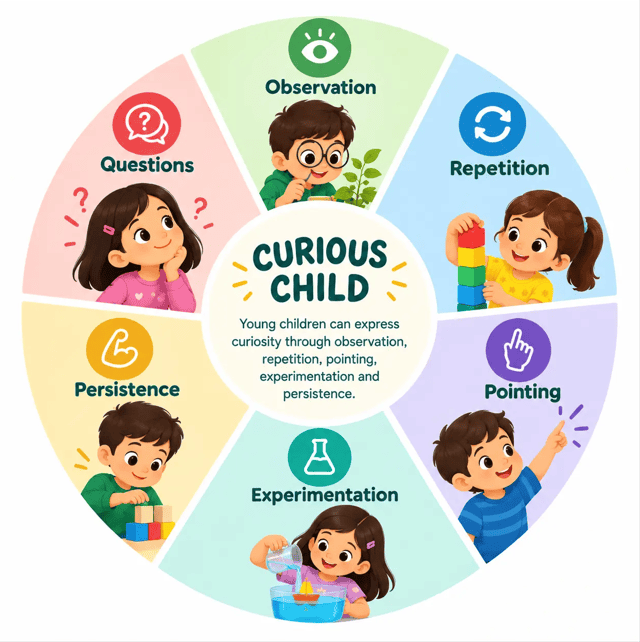
Young children can express curiosity through observation, repetition, pointing, experimentation and persistence. NAEYC describes these behaviours as ways young children explore and make sense of their surroundings.
That distinction matters. A child who asks constant questions makes their thinking visible through language. Another child may show interest by watching carefully, testing an idea or returning to something that caught their attention.
Neither form, by itself, tells us how curious a child is.
The Child Who Watches May Be Investigating
Imagine a teacher placing different objects into a bowl of water.
One child immediately asks, “Will this float?”
Another watches the first object sink, examines a second object and puts it into the water.
Both children are engaging with the same experience, but their responses are different.
NAEYC’s guidance on observing young children explains that careful observation of play can help educators understand children’s interests, thinking and emerging abilities. What a child repeatedly chooses to do can therefore provide useful information alongside what they say.
For parents, this means a quiet child should not automatically be interpreted as uninterested. The useful starting point is to notice how the child engages.
Participation Does Not Have to Look the Same
Preschool learning is not a competition for who answers first.
During a story, one child may interrupt with predictions while another listens until the end. During art, one child may explain every choice while another concentrates on experimenting with colours. During construction play, one child may describe the process while another focuses entirely on building.
These behaviours alone cannot tell us which child is learning more.
A better question is what the child does with the experience. Do they return to it? Try another approach? Notice a change? Copy an action and then alter it? Communicate an idea through words, gestures or actions?
MBIP‘s documented pedagogy reflects this broader approach, combining observation, hands-on experiences, play and meaningful interactions to nurture curiosity and confidence.
Look Beyond the Questions
Instead of counting how many questions your child asks, look for observable signs of investigation.
Do they return to the same activity?
Do they notice small changes?
Do they try something more than once?
Do they watch another child before joining in?
Do they test what happens when they change something?
Do they bring an object to you because they want to understand it?
These behaviours do not prove that a child is curious on their own. But together with sustained interest and exploration, they can give parents useful clues about what has captured a child’s attention.
UNICEF explains that young children’s learning develops through interactions with people, objects and their surroundings, including opportunities to play and explore.
Give Curiosity Room to Develop
Parents do not need to turn every quiet moment into a question-and-answer session.
If your child is watching a snail in the garden, you might say, “I wonder where it is going,” and wait. If they are building a tower, resist the urge to fix it immediately when it falls. Give them an opportunity to try again and notice what changes.
NAEYC recommends giving young children opportunities to investigate, experiment and work through ideas rather than immediately supplying every answer.
The same principle applies when a child is quieter in a group. Rather than pushing them to speak immediately, parents and educators can notice how they are engaging and give them appropriate opportunities to participate.
Being quiet, however, is different from having persistent difficulties with communication or engagement. Quietness alone does not indicate a developmental problem. If concerns about language, interaction, play or development persist, the American Academy of Paediatrics’ recommends discussing them with the child’s doctor.
The goal is not to make every child ask more questions.
It is to notice how each child explores.
A child may investigate by asking, watching, testing, repeating or experimenting. These behaviours can overlap, change from one situation to another and look different across children.
So rather than asking, “Is my child asking enough questions?”, ask:
“What has caught my child’s attention, and what are they doing with it?”
FAQs
1. Is a preschooler who asks fewer questions less curious?
Not necessarily. Children can express curiosity through observation, experimentation, repetition, exploration and persistence as well as through questions.
2. How can parents encourage curiosity without asking too many questions?
Give children time to explore, follow their interests and allow them to test ideas. Open-ended prompts such as “What do you notice?” can encourage thinking without turning exploration into an interview.
3. What should parents look for if their child is naturally quiet?
Look at how the child engages rather than how much they speak. Returning to activities, observing closely, experimenting, imitating actions or communicating through gestures can provide useful clues about their interests.
4. When should parents discuss a quiet child’s development with a doctor?
Quietness alone does not indicate a developmental concern. However, persistent concerns about communication, interaction, play or other areas of development should be discussed with the child’s doctor.
5. How can teachers support a child who prefers to observe?
Teachers can give children time to watch and understand an activity, offer opportunities to participate without forcing immediate verbal responses, and use observations of play to extend the child’s interests.
Sorry, the comment form is closed at this time.