


27 Apr Fun Home Activities That Reinforce What Your Toddler Learns Daily
Yesterday, your child probably asked you the same question three times.
Or sang the same line again and again.
Or lined up the same toys in the same order.
It can feel repetitive. Even unnecessary.
But that repetition is not boredom.
It’s construction.
A toddler’s brain is not collecting information.
It is wiring patterns. And it wires them through repetition that feels safe.
So, the real question is not: “What should I teach at home?”
It is: “What patterns is my child trying to stabilise, and how do I support that?”
At a thoughtfully designed prenursery school, those patterns are introduced through play, rhythm, and interaction. When they continue at home, learning doesn’t need effort.
It becomes instinct.
What Most Parents Get Slightly Wrong?
We assume learning needs to progress constantly.
New words. New skills. New tasks.
But in early childhood, growth often looks like going back, not forward.
The National Curriculum Framework for the Foundational Stage and global early learning research both point to this:
Children don’t learn by adding more. They learn by returning to what feels familiar, until it becomes fluent.
The shift is simple: Don’t introduce more. Stabilise what already exists.
1. Stay in the Moment (Don’t Move Past It Too Fast)
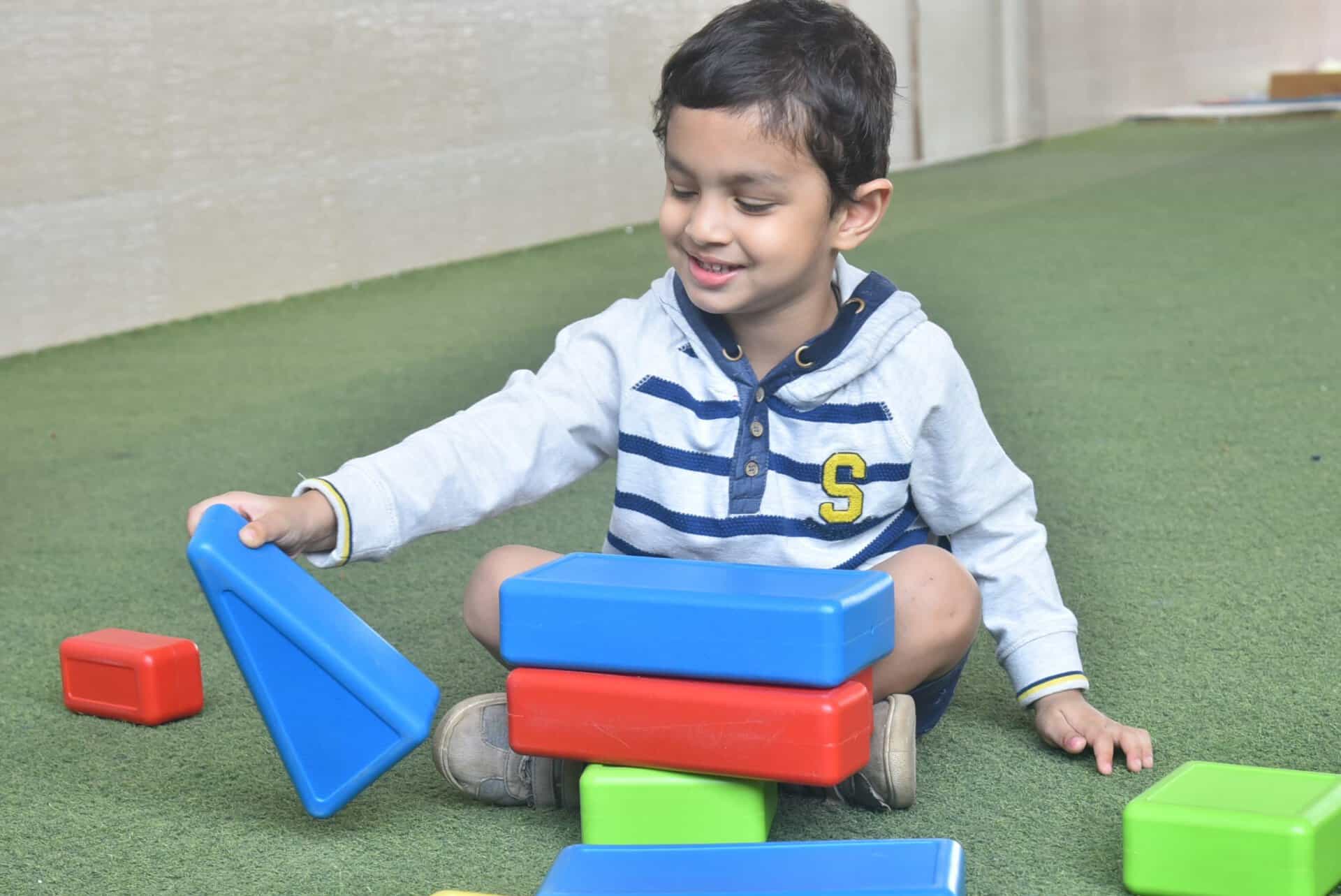
Your child says, “I played blocks.”
Most conversations end there.
Instead, pause and stay:
- “What did you build?”
- “Was it bigger than yesterday?”
- “Did it fall?”
This is not questioning. This is extending the moment.
Harvard’s “serve and return” research shows that when adults respond to a child’s cue and gently expand it, the brain builds stronger connections for language, attention, and memory.
What this really does:
It slows learning down just enough for it to settle properly.
2. Let Repetition Do its Quiet Work
If your child wants the same story again, read it again.
If they stack blocks the same way, let them.
It looks like nothing is changing.
But internally, everything is refining.
Repetition helps toddlers move from:
- Recognising → Understanding → Predicting
India’s foundational learning framework supports this, emphasising familiarity and repeated interaction over forced progression.
What this really does:
It turns effort into confidence.
3. Reflect Their World Back to Them
A child comes home and says, “Teacher sang a song.”
That moment matters more than it seems.
Instead of moving on:
- “Can you sing it for me?”
- “Should I sing with you?”
- “Were you clapping too?”
At MBIP Mumbai, learning is designed around music, storytelling, play, and interaction, not isolated instruction. When those same experiences are mirrored at home, the child recognises the pattern.
And recognition creates a powerful internal message:
“I know how this works.”
What this really does:
It turns learning into something the child can re-enter with ease.
4. Let Movement Carry the Learning
Watch a toddler closely.
They rarely sit still when they are thinking.
They move, jump, balance, repeat.
- Count while hopping
- Walk along floor patterns
- Balance something while crossing a room
The NEP 2025 framework highlights that physical movement is closely linked to early cognitive development.
Movement is not a break from learning.
It is often where learning lands.
What this really does:
It helps the brain organise information through the body.
5. Offer Choices That Build Identity
A small moment:
“Which book do you want?”
It doesn’t feel significant.
But it is.
Because early confidence is not built through success.
It is built through agency.
At MBIP Mumbai, children are given structured freedom, space to choose within safe boundaries. This is not about control. It is about building internal decision-making early.
What this really does:
It shifts the child from waiting to being self-directed.
Why This Feels So Different?
Because it removes pressure.
You are not trying to:
- Teach ahead
- Correct constantly
- Speed things up
You are aligning with how learning naturally happens:
- Repetition
- Familiarity
- Interaction
- Emotional safety
This is not doing less.
This is doing what actually works.
What Makes MBIP Mumbai Distinct?
Many schools say they are play-based.
Fewer design learning so clearly that a child can recognise it outside the classroom.
At MBIP Mumbai, the approach is intentionally built around:
- Repeated patterns of learning
- Music, rhythm and storytelling
- Hands-on exploration
- Interaction-led teaching
This is why children don’t experience school and home as separate worlds.
They experience continuity.
For parents searching for:
- Play schools near me
- Prenursery school
- Best play school in Mumbai
that continuity is often the difference between a child adjusting to school and a child settling into learning.
Final Thought
Watch your child when they repeat something for the third time.
Don’t interrupt it.
Don’t rush it.
That moment is not stuck.
That moment is building.
At MBIP Mumbai, those patterns are introduced with intention.
At home, they become stronger through attention.
And somewhere in that quiet repetition, a child stops trying to learn…and simply starts understanding.
Sorry, the comment form is closed at this time.